
Why This Card Exists & Who Benefits
The Mission: “Aarthik Hal, Yuvaon ko Bal”
The Bihar Student Credit Card Scheme is a core component of the Bihar Government’s “7 Nischay” (7 Resolves) initiative, which falls under the broader commitment of “Aarthik Hal, Yuvaon ko Bal” (Economic Solution, Youth’s Strength). The scheme was launched on October 2, 2016, with a clear social objective: to provide direct financial support to students who are eager to pursue higher education but are held back by their family’s financial constraints. It is fundamentally a social welfare and empowerment tool designed to ensure that no student in Bihar is denied the opportunity for higher learning due to a lack of money.
The Strategic Goal: Boosting Bihar’s GER
Beyond social welfare, the BSCC scheme serves a critical economic and developmental strategy for the state. The primary strategic objective is to significantly improve Bihar’s Gross Enrolment Ratio (GER) in higher education. At the time of the scheme’s conception, Bihar’s GER was approximately 14.3%, lagging significantly behind the national average of 24%.
By providing an accessible, unsecured, and now interest-free loan, the state government is making a direct investment in its human capital. The logic is that by enabling lakhs of students to attain professional and technical degrees, the state will cultivate a more skilled workforce, drive economic growth, and achieve parity with the rest of the nation. The scheme’s generous, non-commercial terms—such as no collateral and a 0% interest rate—are a clear indication that this is viewed as a long-term investment in Bihar’s future rather than a commercial lending operation.
Who is the Ideal Beneficiary?
The ideal beneficiary for the BSCC is a student who meets the following profile:
- Is a permanent resident of Bihar.
- Has successfully passed the 12th standard (or 10th standard for polytechnic courses).
- Comes from a family with limited financial resources (annual income less than ₹6 Lakhs).
- Has secured an admission offer from a recognized, approved educational institution.
- This institution can be located within Bihar or in other states across India, such as West Bengal, Uttar Pradesh, or Andhra Pradesh, provided it is on the official BSCC approved list.
- Needs financial assistance to cover essential academic expenses like tuition fees, hostel charges, and study materials.
Key Features at a Glance (Table)
This table outlines the primary features of the Bihar Student Credit Card Scheme, incorporating all the latest 2025-2026 policy updates.
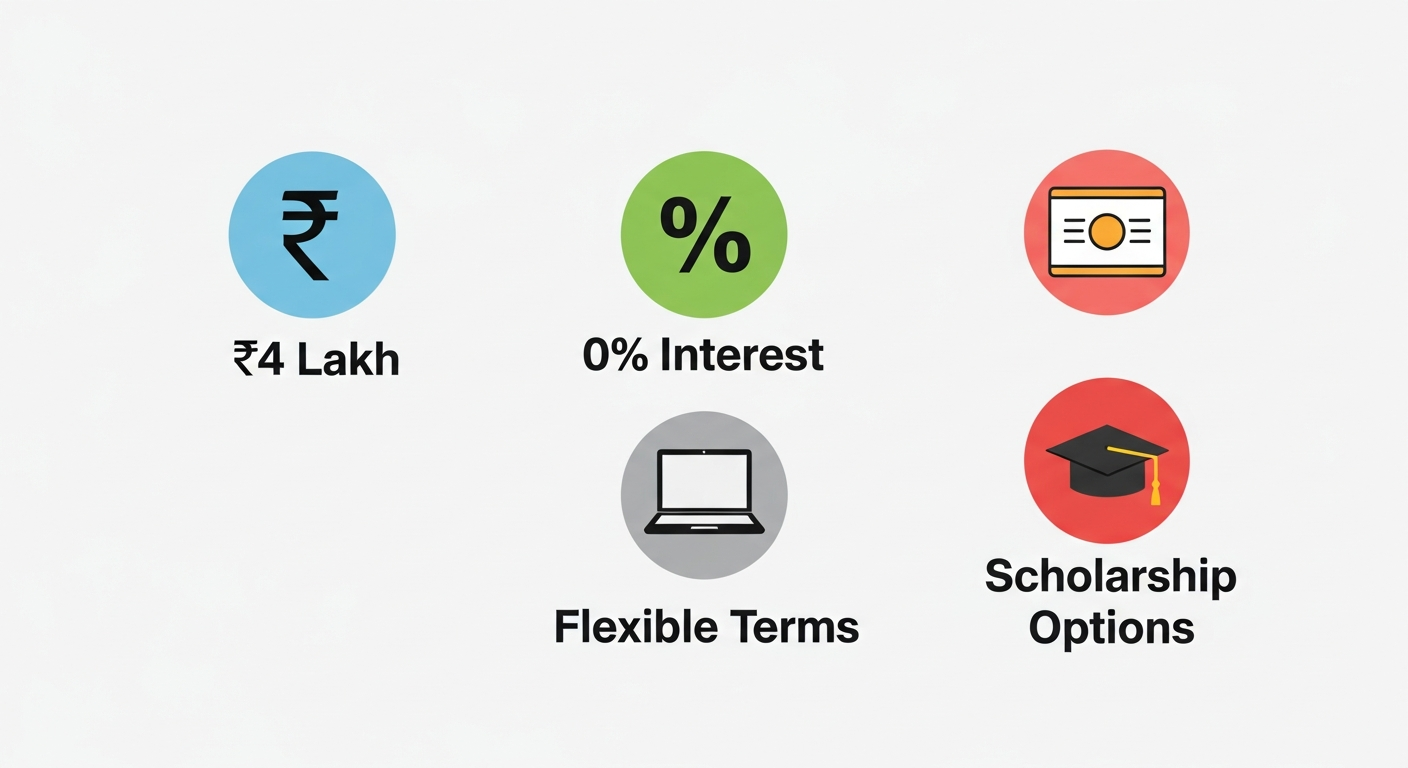
Bihar Student Credit Card (BSCC) Scheme: Key Features (2025-2026)
| Feature | Details | Source Snippet(s) |
| Max Loan Amount | ₹4 Lakhs | |
| Interest Rate | 0% (Interest-Free) for ALL students | |
| Collateral/Security | None Required (Unsecured Loan) | |
| Co-Applicant | Required (Parent/Guardian) | |
| Moratorium Period | Course Duration + 1 Year | |
| Repayment Start | 1 year after course OR 6 months after getting a job (whichever is first) | |
| Repayment Tenure | Max 7 Years (84 installments) for loans up to ₹2L | |
| Repayment Tenure | Max 10 Years (120 installments) for loans above ₹2L | |
| Covered Expenses | Tuition Fees, Hostel/Rent, Laptop, Books, Study Materials |
Eligibility — Full Breakdown
Eligibility for the BSCC is strict and multi-faceted. Failure to meet any one of these criteria is the most common reason for rejection.
Applicant & Residency
- The applicant must be a permanent resident of Bihar state.
- The applicant must have passed the 12th standard (Intermediate) examination.
- Exception: For students pursuing Polytechnic courses, a 10th standard pass is the minimum qualification required.
Age Limit
- For general undergraduate (UG) courses, the maximum age of the applicant should not exceed 25 years.
- For postgraduate (PG) courses, the maximum age limit is relaxed to 30 years.
Family Income
- The applicant’s annual family income from all sources should not exceed ₹6 Lakhs. This must be substantiated with income certificates, ITRs, or Form 16 during document verification.
Institution Eligibility (The Most Important Check)
- This is the most critical hurdle. The applicant must have secured admission to an educational institution that is recognized by the state or central government.
- More importantly, the institution must be present on the “Approved List of College for BSCC”.
- This approved list is available on the 7 Nishchay portal and is updated regularly. It includes hundreds of government and private institutions.
- Crucially, this list is not limited to Bihar. It includes a vast number of colleges and universities across India, including in states like West Bengal , Uttar Pradesh , and Andhra Pradesh. As long as the college is on the list, the student is eligible.
Course Eligibility
- The loan is intended for higher education in general, technical, and professional programs.
- The government maintains a specific list of over 40 approved courses.
- This list includes, but is not limited to:
- General: B.A., B.Sc., B.Com, M.A., M.Sc., M.Com.
- Technical: B.Tech, B.E., B.Sc. (IT/Computer Science), B.C.A., M.C.A..
- Professional: M.B.B.S., B.D.S., B.A.M.S., B.Sc. (Nursing), Bachelor of Pharmacy.
- Management: B.B.A., M.B.A., Hotel Management.
- Teaching: B.Ed., B.P.Ed..
Critical Exclusions (Who is NOT Eligible)
- Management Quota: Students who have gained admission to an institution under the “Management Quota” are not eligible for the BSCC loan.
- Parallel Degrees: A student cannot avail the loan for a second, parallel degree. For example, a student who has already completed a B.Sc. degree cannot use the scheme to fund a B.A. or B.Com degree. However, a graduate can use the scheme for a higher-level degree like an M.B.A. or M.C.A..
- Other Government Aid: The applicant should not be receiving any other similar allowance, scholarship, or loan from any other government source for the same purpose.
Benefits & Limits (What the Card Covers)
The ₹4 Lakh loan is an umbrella limit, and the funds are earmarked for specific educational expenses. The amount is typically disbursed in installments per academic year, often paid directly to the institution.
Institutional Fees
- This is the primary purpose of the loan. It covers the tuition fee and other non-refundable mandatory fees charged by the college or university.
Living & Accommodation
- The loan can be used to pay for hostel fees.
- In cases where a hostel is not available or the student opts for other accommodation, the scheme provides for “livelihood expenditure,” which can be used to rent accommodation.
Study Materials & Equipment
- The loan amount can be utilized for the purchase of essential academic supplies, including books, stationery, and other study materials required for the course.
The Laptop Rule (Important)
- Yes, the BSCC scheme can be used to purchase a laptop, which is considered an essential study tool.
- The Limit: There is a specific cap for this expense. Applicants can claim a maximum of ₹35,000 for the cost of a laptop.
- The Condition: This provision is specifically available for students enrolled in designated “technical courses”. The portal identifies 47 such courses, including B.C.A., M.C.A., B.Sc. (Information Technology), B.Tech, and others.
- The Warning: For students in non-technical courses (e.g., general B.A., B.Com), the “Cost of Laptop” field in the online application will be disabled (frozen). They will not be able to enter an amount for this item.
Step-by-Step: How to Apply (End-to-End)
The BSCC application is a defined, multi-stage process that combines online application with mandatory in-person verification.
Phase 1: Online Registration
- Go to the official Mukhya Mantri 7 Nishchay (MNSSBY) portal: Visit-Now
- On the homepage, click the “New Applicant Registration” button.
- Fill in the required details: Applicant’s Name (must match the 10th certificate), Mobile Number, and Email ID.
- Click “Send OTP.” You will receive an OTP via both SMS and email.
- Enter the OTP to verify your details.
- Upon successful registration, you will receive a confirmation message. Your Username and Password will be sent to your registered email and mobile number.
Phase 2: Filling the BSCC Application Form
- Return to the homepage and log in with the new Username and Password.
- You will be prompted to change your password immediately.
- After logging in with your new password, you must first fill out the “Personal Information Page” with your basic details (address, category, etc.) and submit it.
- Next, you will be taken to the “Select Scheme” page. From the drop-down menu, select “BSCC” (Bihar Student Credit Card) and click “Apply”.
- This opens the detailed BSCC application form. This form requires information for both the Applicant (student) and the Co-applicant (parent/guardian).
- You will need to fill in multiple tabs, including personal details, co-applicant financial/income information, course and institution details, and the loan amount requested.
- The system allows you to “Save as Draft” if you cannot complete the form in one session.
Phase 3: Final Submission & DRCC Appointment
- After filling all tabs, click the final “SUBMIT” button.
- A preview of your entire application will be displayed, along with a warning: “You will not be able to edit any information, after submitting the application…”.
- Confirm to submit. You will receive a confirmation, and a PDF copy of your filled application will be generated and sent to your email.
- At this point, your application is logged. You must now wait for an appointment notification from your district’s DRCC. The DRCC Manager will schedule your visit, and you will be informed of the date and time via SMS and email.
Phase 4: The DRCC Visit (In-Person Verification)
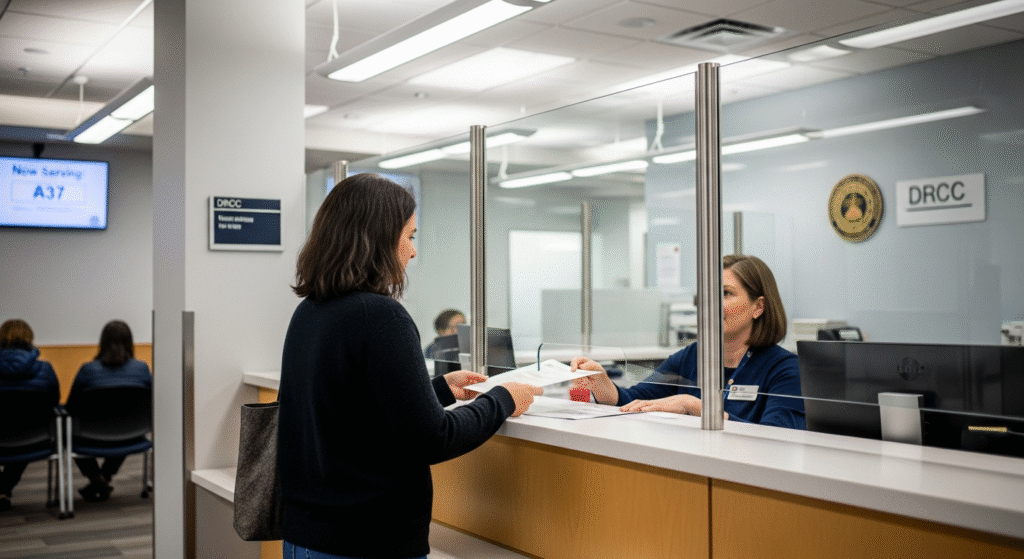
- On your scheduled date, visit your designated District Registration and Counseling Center (DRCC).
- This is the most critical step. You must bring all original documents and a set of self-attested photocopies (see checklist below).
- At the DRCC counter, a Multi-Purpose Assistant (MPA) will handle your application. They will:
- Authenticate your identity using your Aadhaar.
- Physically inspect your original documents and verify them against the photocopies.
- Scan all your required documents into the system.
- Capture your live photograph.
- Upon successful verification, the MPA will give you a physical acknowledgment slip, confirming your documents have been processed.
Phase 5: Back-End Processing (The “Waiting” Period)
- Your application is now in the system. It is first verified by a DRCC Assistant Manager for a second check.
- It is then electronically passed to a Third Party Verification Agency (TPA). The TPA validates the authenticity of your documents (especially academic and residency proofs).
- After the TPA verification report is submitted, the application is forwarded to a Nominated Officer from the Education Department.
Phase 6: Bank Sanction
- The Education Department officer forwards your approved application to the concerned bank that will service the loan.
- The bank reviews the file and, upon approval, confirms the loan sanction and uploads the official sanction letter to the portal.
Phase 7: Collection & Disbursement
- You will receive a final SMS and email, this time from the DRCC, informing you that your loan is sanctioned and ready for collection.
- You must visit the DRCC one last time to collect your “Student Credit Card” and the bank’s loan sanction letter.
- With the sanction letter in hand, you must visit the designated bank branch to complete the final loan agreement documentation and formalities.
- Once the paperwork is signed, the bank will disburse the loan amount, typically by paying the institution fees directly to your college.
Documents Checklist (For DRCC Verification)
You must bring self-attested photocopies of the following documents to your DRCC appointment. Bring the originals for verification.
Student (Applicant) Document Checklist
- [ ] Filled Common Application Form: The PDF copy you received via email.
- [ ] Aadhaar Card.
- [ ] PAN Card.
- [ ] 10th Standard (Matric) Marksheet & Certificate.
- [ ] 12th Standard (Intermediate) Marksheet & Certificate.
- [ ] Proof of Admission: Admission letter or bonafide certificate from your college.
- [ ] Fee Schedule: A detailed, institute-signed document showing the course fees, semester by semester.
- [ ] Proof of Residence: (e.g., Residence Certificate, Voter ID, Driving License, Passport).
- [ ] Bank Passbook: Copy of the first page of your bank passbook (showing account number, name, and IFSC code).
- [ ] Passport-size Photographs: 2 copies.
Co-Applicant (Parent/Guardian) Document Checklist
- [ ] Aadhaar Card.
- [ ] PAN Card.
- [ ] Passport-size Photographs: 2 copies.
- [ ] Proof of Residence: (If different from the student).
- [ ] Income Proof (Crucial):
- [ ] Last year’s Income Certificate or Form 16.
- [ ] Last 2 years’ Income Tax Returns (ITR), if applicable.
- [ ] Bank Statement: Last 6 months’ bank account statement.
How Repayment & Interest Work (Examples)
This section contains the most significant updates to the scheme. The terms have been made exceptionally favorable for students.
The BIG 2025 Update: 0% Interest for ALL
In September 2025, the Bihar Government announced a landmark change to the BSCC scheme.
- The loan is now completely interest-free (0% interest) for all new applicants.
- This removes the previous structure of 4% interest for male students and 1% for female, transgender, and Divyang students.
- This change makes the BSCC one of the most financially attractive education loan products in the country. Any source or website still quoting the 4% or 1% interest rate is citing outdated information.
The Moratorium (No-Payment) Period
Students are not required to make any payments during their studies. This no-payment “moratorium period” includes the entire duration of the course plus one additional year after its completion.
When Repayment Starts
Repayment of the loan begins after the moratorium period ends (i.e., one year after course completion).
- Exception: If a student secures employment before the moratorium period is over, the repayment will start six months after the date of securing a job (whichever comes first).
New Repayment Tenure (2025 Update)
Along with the interest waiver, the state government also extended the repayment period to reduce the monthly burden on students.
- For loans above ₹2 Lakhs: The repayment tenure has been extended from 7 years to a maximum of 10 years (120 monthly installments).
- For loans up to ₹2 Lakhs: The repayment tenure has been extended from 5 years to a maximum of 7 years (84 monthly installments).
EMI Calculation Examples (At 0% Interest)
With a 0% interest rate, the Equated Monthly Installment (EMI) is a simple calculation of the principal amount divided by the number of months.
Example 1: Full ₹4 Lakh Loan (e.g., B.Tech / M.B.B.S. Student)
- Total Loan Amount: ₹4,00,000
- Interest Rate: 0%
- Repayment Tenure: 10 years (120 months)
- EMI Calculation: ₹400,000 / 120 months $
- Your EMI: ₹3,333 per month
Example 2: ₹1.5 Lakh Loan (e.g., B.A. / B.Com Student)
- Total Loan Amount: ₹1,50,000
- Interest Rate: 0%
- Repayment Tenure: 7 years (84 months)
- EMI Calculation: ₹150,000 / 84 months
- Your EMI: Approximately ₹1,786 per month
The “Unemployment Safety Net”
The scheme includes a crucial “safety net” for students who may not find a job immediately after the moratorium period.
- If a student remains unemployed when the repayment is scheduled to begin, the repayment is deferred.
- To avail this, the student must submit an affidavit of unemployment to the DRCC.
- Repayment will only resume after the student secures employment.
Application Timeline — What to Expect
Understanding the timeline is key to managing the application process and reducing anxiety.
The “Official” Target Timeline (Post-DRCC Visit)
The official process flow provides a clear, though optimistic, timeline after your documents are submitted at the DRCC :
- TPA Verification: The Third Party Agency (TPA) has 15 days to complete its verification and submit its report.
- Bank Sanction: After receiving the file from the Education Dept., the bank has 15 days to sanction the loan and upload the sanction letter.
Total Ideal Time: This puts the “best-case” scenario at approximately 30 days from your DRCC visit to loan sanction.
The “Real-World” Timeline & Why It’s Often Longer
It is important for applicants to be aware that the process can often take “much more time” and be “very very complex”. User-reported experiences suggest that delays are common.
- Why the Delay? Delays are almost never random. They are typically caused by:
- Document Errors: Mismatched names, unclear scans, or missing co-applicant financial papers.
- TPA Queries: The TPA may raise a query on your application, pausing the 15-day clock until you provide the required clarification or additional document.
- Bank Backlog: The specific bank branch assigned to your application may have its own internal backlogs or processing queues.
How to Track Your Status
Applicants are not left in the dark. There are two primary ways to track an application:
- Online Portal: Use the “Application Status” link on the MNSSBY portal.
- Helpline: Call the toll-free helpline number (1800 3456 444) for updates.
Common Problems & Solutions (Troubleshooting Guide)
Here is a guide to solving the most common issues applicants face.
Problem 1: My application was rejected.
- Reason: “Verification Failure” or “Incorrect or Mismatched Details”. This is often due to technicalities. The TPA might have found your scanned residence proof to be blurry, your name on the application does not exactly match your 10th certificate, or a document was expired.
- Reason: “Course/Institution Not Recognized”. This is an eligibility failure. The college or course you applied for is not on the government’s approved lists.
- Solution: For verification failures, you must visit the DRCC with your original documents and the rejection notice. They can guide you on re-verification or re-application. For eligibility failures, the loan cannot be approved; you would have to secure admission in an approved institution.
Problem 2: My application is “stuck” (e.g., at DRCC, TPA, or Bank) for weeks.
- Solution: Be proactive. Do not wait indefinitely. Follow this escalation path:
- Step 1: Call the Toll-Free Helpline at 1800 3456 444 and ask for a specific status update.
- Step 2: If the helpline is not helpful, contact your District’s DRCC Manager directly. The official MNSSBY portal has a “Contact Us” page with the mobile numbers for nearly all district DRCC managers. A direct call can often resolve a stalled file.
- Step 3: File a formal grievance using the “Feedback and Grievance” portal on the MNSSBY website. This creates a formal record of your complaint.
Problem 3: My loan is approved, but the bank hasn’t disbursed the funds.
- Solution: At this stage, your file is outside the DRCC’s hands.
- Step 1: Contact the assigned bank branch manager directly.
- Step 2: If the bank is unresponsive, your next point of contact is the Bihar State Education Finance Corporation (BSEFC). They are the financial body managing the funds and can follow up with the bank.
Problem 4: I’m paying my EMI, but the portal shows “Default.”
- Solution: This appears to be a known issue, according to user forums. The portal’s payment updates can be slow.
- Step 1: Do not panic and do not stop paying your EMI.
- Step 2: Keep meticulous records (bank transaction IDs, receipts) of every payment.
- Step 3: Write an application and visit the BSEFC office in Patna with your proof of payment to have your record manually rectified.
Tips to Improve Your Application Approval Odds
Based on common rejection reasons, here are four expert tips for a smooth application.
- Tip 1: Do the “Triple Check” Before Applying. Before you fill out a single field, go to the “Approved List of College for BSCC” on the MNSSBY portal. Check three things:
- Is your college on the list?
- Is your specific course on the list?
- Are you in a “Management Quota” seat? (If yes, you are ineligible). This five-minute check prevents the most common and irreversible rejection reason.
- Tip 2: Gather Your Co-Applicant’s Documents First. The biggest delay is often not the student’s documents, but the co-applicant’s. The ITR, 6-month bank statement, and income certificate are mandatory. Have these documents scanned and ready before you begin the online application.
- Tip 3: Be a “Perfectionist” on the Form. The TPA verification is not flexible. Your name must be spelled exactly as it appears on your 10th-grade certificate and Aadhaar card. A “Mismatched Detail” , such as “Ravi Kumar” vs. “Ravi Kr.”, can be grounds for a TPA rejection. Be meticulous.
- Tip 4: Use a High-Quality Scanner. Do not use a blurry photo from your phone. A common TPA rejection is “Invalid document photo” or “Unclear proof of address”. Go to a computer or photostat shop and get clear, 300-dpi PDF scans of all your documents.
Frequently Asked Questions (Detailed)
Q1: Is the Bihar Student Credit Card really interest-free now?
Answer: Yes. This is a recent and official policy change announced by the Bihar Government in September 2025. The BSCC loan is now 100% interest-free (0% interest) for all new applicants, regardless of gender or category.
Q2: Can I apply if I want to study in Delhi, Kolkata, or another state?
Answer: Yes, absolutely. The scheme is not limited to colleges in Bihar. The government maintains an “Approved List of College for BSCC” which includes hundreds of recognized institutions across India, including in Delhi, West Bengal, Uttar Pradesh, Andhra Pradesh, and more. As long as your chosen college is on this official list, you are eligible.
Q3: Can I buy a MacBook or a high-end laptop with the loan?
Answer: Only partially. The scheme specifically caps the maximum amount available for a laptop purchase at ₹35,000. Furthermore, this provision is only available to students enrolled in approved “technical courses” (like B.Tech, M.C.A., B.Sc. IT). If you are in a non-technical course (like B.A.), this option will likely be disabled on your application.
Q4: What is the CIBIL score required for my parents (co-applicant)?
Answer: The official guidelines and process flow for the BSCC scheme do not specify a minimum CIBIL score for the applicant or co-applicant. This is not a traditional, credit-based loan. The primary financial check is on the family’s income level (must be less than ₹6 Lakhs annually) , which is verified using documents like ITRs, income certificates, and bank statements.
Q5: What is the DRCC and TPA?
Answer: The DRCC (District Registration and Counseling Center) is the government office in your home district. You must physically visit the DRCC for your mandatory document verification. The TPA (Third Party Agency) is an independent organization that performs a second-level, back-end verification of your documents after you have visited the DRCC.
Q6: I am in a “Management Quota” seat. Am I eligible?
Answer: No. The scheme guidelines explicitly state that students who have secured admission through a “Management Quota” are not eligible for the Bihar Student Credit Card loan.
Q7: What is the official helpline number?
Answer: The official toll-free helpline number for all queries related to the 7 Nishchay schemes, including BSCC, is 1800 3456 444.